


Invoice Maker & Estimating App
JobFLEX
When I need to prepare an invoice or estimate away from a desk, I want something that gets out of the way quickly. Invoice Maker & Estimating App is built for that situation: it is a business app from JobFLEX aimed at contractors and small businesses that need to create documents while moving between jobs. I found its purpose easy to understand, but the practical experience depends heavily on how carefully the first setup is handled.
The app is free to start, with optional in-app purchases ranging from $7.99 to $89.99 per item. That makes it approachable for testing, although anyone planning to rely on it regularly should pay attention to which tools are included before building an entire billing routine around it. My overall impression is that it is more useful as a mobile document-making tool than as a complete replacement for accounting software.
Getting past the first points of friction
The most common difficulty is not creating a line item; it is making sure the business information, customer details, descriptions, and totals are entered consistently. A small mistake in a company name or service description can make an otherwise professional estimate look unfinished. I recommend treating the first session as preparation rather than trying to produce a customer-ready invoice immediately.
Start by checking the business identity you intend to place on documents. Use the same spelling, phone details, and address format you use elsewhere. This matters especially for contractors who may send estimates from a vehicle or from a job site, where there is little time to proofread. A clean base setup saves more time than repeatedly correcting individual documents.
Next, think about how you describe recurring work. Instead of entering vague labels such as “labor” or “materials,” prepare practical descriptions that make sense to the customer. For example, a repair visit, installation task, or material allowance should be recognizable without a separate explanation. This is one of the app’s less obvious strengths: a mobile invoice can still feel organized if the wording is prepared before the rush begins.
Related News

Why WhatsApp Messenger Still Makes Everyday Communication Feel Easy

Jurassic World: The Game Is the Better Dino Tycoon for Strategic Players

Threads in Real Life: Who Should Join, Lurk, or Leave

How SHEIN Turned Shopping Into an Endless Content Feed

How to Make Fortnite Feel Smarter on Mobile

Should You Switch to Microsoft Outlook on Mobile?
The best time to prevent mistakes is before the first real customer document. I would create a private practice estimate, review every visible field, and only then use the workflow for paid work. That approach also helps reveal whether the app fits the way you price jobs, particularly if your work combines fixed project amounts with several smaller charges.
Setup checks that make mobile billing smoother
Because this is designed for work on the go, I would not wait until standing in front of a customer to discover that a business detail or item description needs editing. Prepare a small set of common services and materials in advance if the app’s available tools support the way you work. The goal is not to turn the app into a complicated catalog; it is to reduce repetitive typing and make each document easier to review.
Before sending anything, check the difference between an estimate and an invoice in your own process. An estimate communicates expected work and cost, while an invoice requests payment for work or goods already supplied. That distinction is easy to blur when both documents are created from a phone. I would read the document from the customer’s point of view and confirm that its purpose is immediately clear.
Gallery
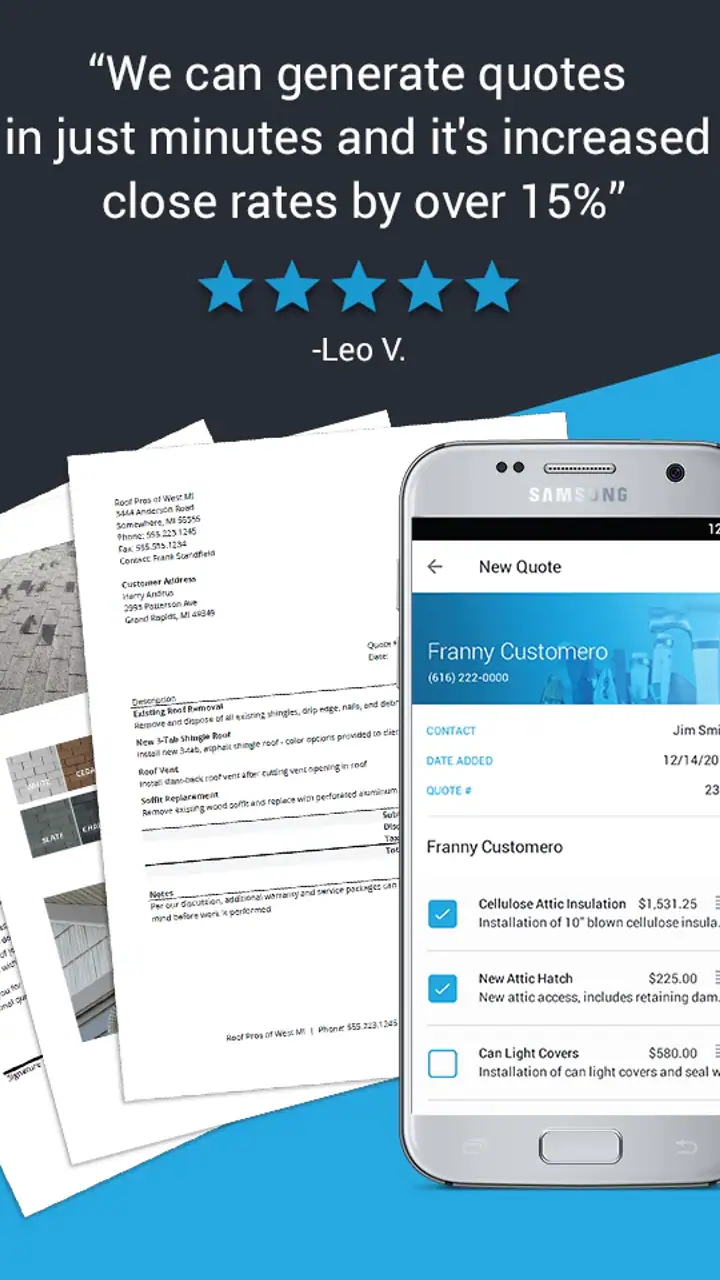
Totals deserve a separate check. Review quantities, rates, discounts, taxes, and any added charges rather than assuming the final amount is correct because the entries look right. If your business uses special tax rules or complicated deposits, compare the result with your normal accounting method. A simple mobile app is convenient, but convenience should not replace a financial review.
Another useful habit is to keep customer names consistent. If one job is entered under a personal name and another under a company name, finding the correct document later becomes harder. Consistent naming is particularly valuable for contractors who return to the same customers for maintenance or follow-up work.
The app has an Everyone content rating and supports older devices, with a minimum operating system of Android 4.1. That broad compatibility can be helpful if a business uses an older phone for field work. Still, compatibility alone does not guarantee a smooth experience: an aging device, limited storage, or an unstable connection can make any document workflow feel unreliable.
A realistic job-site workflow
Imagine finishing a small installation in the afternoon. The customer wants a clear record before you leave, but you do not want to open a laptop, reconstruct the job from memory, and type everything later. I would open the app, select or enter the customer, add the work in plain language, review the amount, and inspect the document once as if I were the recipient. Only after that check would I use the available sharing or delivery step.
The important part is the pause before sending. On a phone, it is easy to tap through a form quickly and miss a duplicated line, an incomplete description, or a total that does not match the conversation. A ten-second review is more valuable than trying to repair confusion after the customer receives the document.
For estimates, I would use the app during the initial conversation but avoid treating the first figure as final when the job still needs inspection. A quick estimate is useful for setting expectations, yet unusual materials, hidden damage, or changing scope can make a simple number misleading. The app can help present the figure; it cannot inspect the property or make a judgment about the work.
Recovering when a document or workflow goes wrong
If an invoice contains an error, my first step would be to stop creating more copies. Repeatedly editing and resending documents can leave the customer unsure which version is current. I would identify the incorrect field, correct the source information, and then clearly communicate which document should be used. Keeping a simple external note of the customer, job, and document status is sensible for important work.
When the app appears slow or fails to behave as expected, I would separate the problem into three questions: is the issue limited to one document, does it happen with every customer, and does it continue after restarting the app? This basic process avoids deleting useful information or changing several settings at once. It also makes any later support conversation much clearer.
For a document that will not save or send, I would first preserve the information manually. Write down the customer, line items, quantities, and total before trying more troubleshooting. Then check the phone’s connection, reopen the app, and attempt the smallest possible action. If the problem affects only one unusually detailed document, recreate a simple test document to determine whether the issue is with the workflow or with that particular entry.
I would avoid assuming that reinstalling is the answer. Removing a business app can create a bigger problem if local work has not been preserved. A safer recovery habit is to keep important customer and job information in the business records you already use, then use the mobile app as a convenient document tool rather than the only place where the information exists.
Version 8.3.3 is the current version shown for the app, so keeping the installed copy reasonably current is a sensible first check when behavior differs from what you expect. At the same time, an update is not a universal fix. If the issue is caused by an incorrect amount, an incomplete customer record, or a network interruption, changing versions will not solve the underlying mistake.
When the app is not really the cause
Some frustrations blamed on invoice software actually come from the surrounding business process. If customers are confused by an estimate, the wording may be too broad. If a payment is late, the issue may be the agreed terms or the follow-up routine rather than the document itself. If totals are repeatedly wrong, the pricing method needs attention before another app is considered.
There is also a limit to what a mobile invoice maker should be expected to do. Businesses with inventory tracking, payroll, detailed tax reporting, recurring billing, extensive customer histories, or formal bookkeeping integrations may be better served by dedicated accounting software. Those systems usually require more setup, but the added structure can be worthwhile when the business has outgrown simple estimates and invoices.
On the other hand, a contractor who mainly needs a readable estimate after a site visit may find a full accounting platform unnecessarily heavy. In that case, the lighter approach is the advantage. I would choose this app for speed and portability, not because it replaces every financial task a growing company may eventually need.
The rating is currently a 3.4 average from around 1K ratings, with 489 written reviews. I read that as a sign to keep expectations practical: the app has a clear use case, but the experience may not be equally smooth for every workflow or device. Its install base of over 100K also shows that it is not an obscure experiment, though popularity should not be confused with a guarantee that it matches your billing habits.
Who should use it and who should skip it
I think Invoice Maker & Estimating App is a reasonable fit for independent contractors, tradespeople, repair specialists, and small operators who need to prepare straightforward customer documents away from an office. It is especially appealing when the alternative is handwritten paperwork, delayed invoicing, or carrying a laptop to every appointment.
I would be more cautious if your work depends on complex tax treatment, multiple currencies, detailed stock control, formal approval chains, or deep accounting reports. In those cases, the time saved at the job site may be lost later when information has to be transferred into another system. A dedicated accounting platform may be the better primary tool, with this kind of app used only if the two workflows can be kept consistent.
The free entry point makes testing easier, but I would explore the actual limits before committing to paid features. Since optional purchases run from $7.99 to $89.99 per item, the sensible approach is to begin with a small real-world trial: create a few estimates, prepare an invoice, review the document from another device if possible, and decide whether the available workflow justifies further spending.
My practical verdict after using it as a field tool
Invoice Maker & Estimating App works best when you treat it as a focused field companion. Its value is not in replacing a complete office system; it is in helping a small business turn job details into a presentable estimate or invoice while the work is still fresh. That can make a noticeable difference for someone who otherwise postpones paperwork until the end of the day.
I like the direct purpose and the fact that it can suit older Android devices. I also appreciate that its usefulness grows when the owner prepares consistent descriptions and checks every total before sending. Those habits are not glamorous, but they are what make a simple invoicing workflow dependable.
The drawbacks are equally practical. Mobile entry can be tiring for complicated jobs, mistakes are easy to make when working quickly, and businesses with advanced accounting needs may outgrow the format. The optional purchases also mean that “free” should be understood as an opportunity to test the workflow, not as a promise that every useful capability will remain available without payment.
My recommendation is to try it with a controlled set of real jobs rather than judging it from one rushed invoice. If your needs are clear estimates, basic invoices, and quick field paperwork, it may be a good fit. If you need a complete financial record, use a more comprehensive accounting solution instead. For the right small business, the app earns its place by reducing delay, provided you keep a separate habit of checking and preserving important records.
FAQs for Invoice Maker & Estimating App
What is Invoice Maker & Estimating App used for?
Invoice Maker & Estimating App is designed for freelancers, contractors, small businesses, and independent professionals who need to create estimates, invoices, receipts, and payment records from a mobile device. During testing, its main benefit was the ability to prepare professional-looking documents quickly without requiring advanced accounting knowledge or a complicated desktop setup.
Can I customize invoices and estimates before sending them?
Yes, the app generally allows users to add business details, customer information, services or products, prices, taxes, discounts, notes, and payment terms. You can usually adjust the document appearance with available templates or branding options, although the exact level of customization may depend on the selected plan. It is worth checking the preview carefully before sending or exporting a document.
Can I send invoices directly to customers and accept payments?
The app can typically export invoices as PDF files and share them through email, messaging applications, or other supported services. Depending on your region, account type, and subscription, it may also offer online payment features or payment links. Users should verify transaction fees, supported payment methods, and availability in their country before relying on the app for customer payments.
Is Invoice Maker & Estimating App free to use?
The application may provide a free version or trial with access to basic invoice and estimate creation, but some features can be restricted by subscriptions, in-app purchases, branding limits, document quotas, cloud storage, or advanced reporting tools. Before downloading, review the pricing page and trial conditions carefully, especially the automatic renewal terms, so you understand what will remain available without payment.
Is my business and customer information secure in the app?
Because the app may store names, addresses, contact details, invoice histories, and financial information, privacy and security should be considered before regular use. Check the developer’s privacy policy, permissions, backup options, and account protection features. Avoid entering sensitive payment credentials unless the payment provider is trusted, and keep exported invoices or backups protected on your device and cloud accounts.
Pros
- Create professional invoices quickly from your phone.
- Convert estimates into invoices with minimal effort.
- Supports recurring invoices for regular customers.
- Track payment status and outstanding balances easily.
- Useful templates help maintain a consistent business image.
Cons
- Some advanced features may require a paid subscription.
- Customization options can feel limited for complex invoice designs.
- Cloud syncing may depend on account setup and internet access.
- Small businesses may find the interface crowded at first.
- Payment processing availability can vary by country and provider.


